


A good example of museum co-curation
 Image by Peggy_and_Marco_Lachmann-Anke from Pixabay
Co-curation is a mainstream approach in the world of museums, shaped by funding, policy, and inclusion agendas. Although widely used in projects and exhibitions, it remains unevenly embedded, with institutions balancing how far to go with this approach versus less costly methods.
We recently evaluated a museum programme that included a co-curation project. One of the most striking observations was how deliberately, and necessarily so, the process unfolded over time. While co-curation is often framed as a discrete activity within a project plan, in practice it emerged here as the result of sustained relationship-building, trust, and iterative engagement with a group of young people.
At the outset, the museum team had limited prior experience of co-curation. Rather than rushing into collaborative decision-making, they prioritised creating a welcoming and informal environment. Early sessions were intentionally low-pressure, incorporating activities such as object handling. Items linked to relevant historical characters generated conversation and laughter, helping participants to feel at ease within the museum space. The evaluation indicated this phase was critical. It became clear that meaningful participation depended on participants feeling comfortable enough to express themselves openly.
Learning: Co-curation is contingent on trust, and trust takes time to develop.
Attempting to co-curate too early would likely have limited the depth and authenticity of contributions.
As relationships strengthened, the project moved into a more exploratory phase. Participants were invited to engage with the museum’s interpretation of LGBT+ histories, using prompts to reflect on what was present, what was missing, and how stories could be told differently. Notably, they were encouraged to think beyond content alone, considering formats such as immersive or game-based experiences.
Learning: Effective co-curation involves opening up decisions about both content and interpretive approach.
Participants responded positively when given the freedom to shape not just what was presented, but how it was experienced.
The introduction of a specialist consultant marked a transition into structured co-design. Participants worked collaboratively to develop ideas, construct prototype interpretations, and test them with one another. Observationally, these practical, creative activities appeared to deepen engagement and foster a strong sense of ownership. Ideas became more concrete, and participants increasingly articulated their preferences with confidence.
Learning: Participatory design methods—particularly hands-on prototyping—support deeper engagement and ownership.
At the same time, the evaluation highlighted the realities of working within institutional constraints. The initial concept evolved over time due to practical considerations, including space, staffing, and budget. The final outcome, a distributed interactive trail, had evolved from the original vision but retained its core elements. Importantly, participants remained involved in these adaptations, rather than being excluded from decision-making at this stage.
Learning: Transparency about constraints, combined with continued participant involvement, helps maintain the integrity of co-curation.
Feedback gathered during the later stages of the project indicated that participants felt their contributions were valued and that they had a genuine voice in shaping the outcome. The final celebration event provided a particularly strong indication of this: participants expressed excitement and, in some cases, surprise that their ideas would be realised within the museum. This sense of ownership was a key indicator of successful co-curation.
Learning: Participants need to see clear evidence of their impact for co-curation to be meaningful.
Finally, the evaluation underscored the importance of time. From initial engagement to the launch of the new interpretation, the process spanned nearly two years, with approximately one year dedicated to developing and implementing the core idea . This extended timeframe allowed for the gradual development of trust, the iterative refinement of ideas, and the practical delivery of the final interpretation.
Learning: Co-curation should be understood as a long-term, iterative process rather than a one-off activity.
Overall, this case demonstrated that successful co-curation requires more than simply inviting participation. It depends on creating the conditions in which participants feel comfortable, valued, and able to influence outcomes, while also navigating the practical realities of museum work. From an evaluative standpoint, the project provides a strong example of how these elements can be brought together to achieve meaningful collaboration.
While a theoretical framework was not used as a basis of the co-curation, the project aligned most closely with partnership on Arnstein’s Ladder of Citizen Participation, level 6 of a potential 8 levels [1]. The young people were not simply consulted; they were actively involved in shaping the interpretation, contributing ideas that directly influenced the final outcome. Their sustained engagement across multiple sessions, and their role in developing narrative, format, and design, demonstrated a meaningful sharing of decision-making. At the same time, the museum retained responsibility for feasibility, including budget, space, and delivery, which ultimately framed what could be realised. As such, while the project stopped short of delegated power or full citizen control, it represented a strong example of partnership in practice, where influence was genuine, visible, and valued, but exercised within the necessary constraints of the institution.
[1] Arnstein, S. R. (1969). A Ladder Of Citizen Participation. Journal of the American Institute of Planners, 35(4), 216–224. https://doi.org/10.1080/01944366908977225
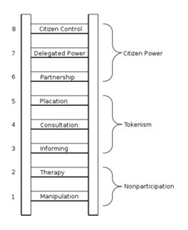
Arnstein’s Ladder of Citizen Participation (1969), illustrating increasing levels of citizen power from non-participation to citizen control