


Just Theory or Practically Useful?
We’ve started quite a few new evaluation projects recently. So, we’ve spent quite a lot of time developing Theories of Change (including logic models) over the last few weeks. That got Alun, our Director, pondering the importance of a Theory of Change. We find them useful as evaluators, but do they offer anything of practical value to project managers?
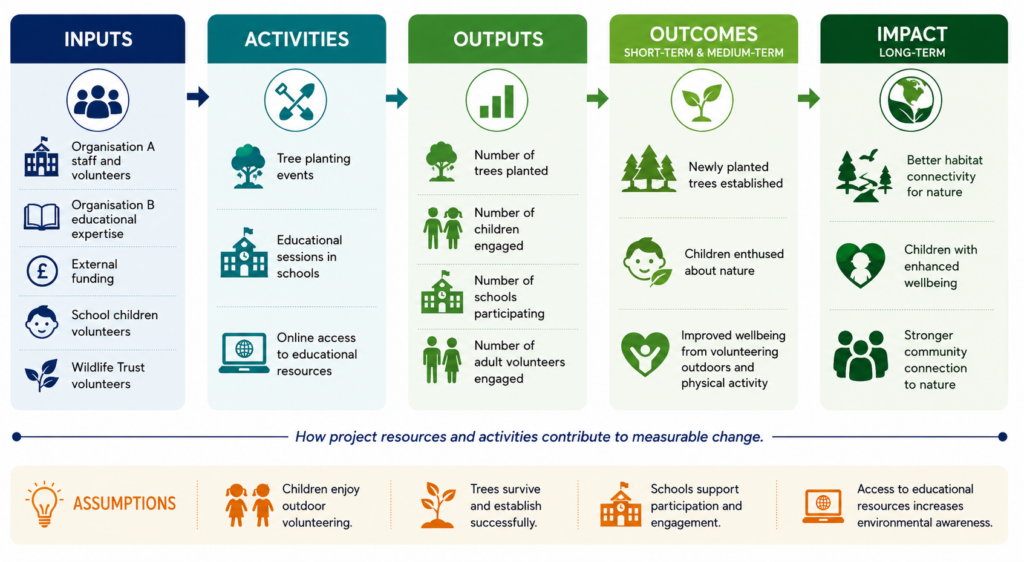
At its simplest, a Theory of Change describes how and why a project expects to achieve its intended outcomes. It sets out the logical pathway from inputs to activities to outputs and, ultimately, to the outcomes the project hopes to create. That may sound abstract, but it helps answer some very practical questions.
Are we focusing on the right things?
Projects often begin with a long list of activities. A Theory of Change encourages teams to step back and ask, “How do these activities actually lead to the change we want to see?”. This can reveal gaps in planning, unrealistic assumptions, or activities that consume time and resources without contributing significantly to desired outcomes.
What should we be measuring?
Some projects collect large amounts of monitoring data but struggle to demonstrate impact. A Theory of Change helps identify the outcomes that matter most and provides a framework for deciding what evidence to collect. Rather than measuring everything, teams can focus on the indicators that tell them whether meaningful change is occurring.
How do we adapt when circumstances change?
Few projects unfold exactly as planned. New opportunities emerge, external conditions change, and unexpected challenges arise. A Theory of Change provides a reference point for decision-making. When considering a change in direction, teams can ask, “Will this help us achieve the outcomes we are aiming for?” If the answer is yes, adaptation becomes easier to justify.
How do we explain our work to others?
Whether speaking to funders, partners, trustees or participants, projects often need to explain not only what they do but why they do it. A clear Theory of Change tells a coherent story about the project’s purpose and approach. Ideally it does that concisely. So, it helps stakeholders understand the rationale behind activities and the difference the project hopes to make.
A Tool for Learning
As evaluators, we tend to use a Theory of Change throughout an evaluation, but most Project Managers tend to regard it as a task to be completed at the start of a project and then forgotten. However, a Project Manager can use their theory of change throughout a project’s life to test assumptions, reflect on progress and support learning.
So, far from being a theoretical exercise, a Theory of Change can become a practical guide for delivering successful projects and achieving meaningful change.